


- News
AIRoA Announces CoRL 2026 Workshop “The UMI Arena”
2026-08-21


Real-World Robot Manipulation Data Collected with YUBI to Support an International Competition on a Shared Real-Robot Platform
AIRoA is pleased to announce that its workshop proposal, “The UMI Arena: From Handheld Devices to Real-World Policies,” has been accepted for presentation at the Conference on Robot Learning 2026 (CoRL 2026), an international conference on robot learning scheduled in the United States in Austin, Texas, from November 9 to 12, 2026.
The workshop will focus on collecting robot manipulation data with handheld devices and learning robot policies from that data. By examining policies, data-collection devices, and research contributions side by side under shared tasks in a common real-robot environment, the workshop aims to advance the standardization of real-world robot manipulation evaluation.
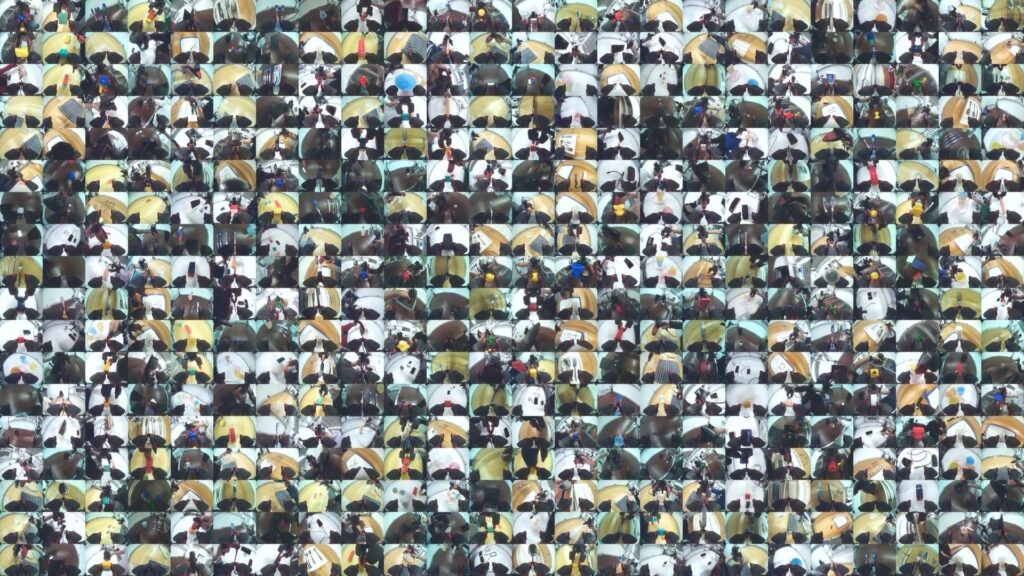
At the center of the workshop is the UMI Arena, an international competition during which policies developed by participating teams will be evaluated on a shared real-robot platform. To support model development, a subset of real-world robot manipulation data collected using AIRoA’s YUBI (*1)-based data-collection infrastructure, as well as a reference policy model and training code, will be made available exclusively to the participating teams through private GitHub repositories.
The workshop will also feature a hands-on exhibition where attendees can try and compare UMI-class data-collection devices, and a paper and poster session for related research. By connecting data collection, model training, and real-robot evaluation end to end, the workshop will create an international forum where researchers and engineers can work together on shared challenges.
The invited speakers are expected to include Shuran Song, Andy Zeng, Hao-Shu Fang, and Yang Gao, leading researchers in robot learning and real-world robot manipulation.
Background: The Growing UMI Ecosystem and Need for Shared Evaluation
Training robots to perform diverse tasks requires large-scale manipulation data; however, conventional data collection with physical robots entails substantial equipment and operating costs.
To address this, robot-free data collection using handheld devices, pioneered by the Universal Manipulation Interface (UMI), has emerged as a promising alternative. A growing range of open-source devices is making scalable data collection increasingly feasible.
Still, because research groups often use different robots, tasks, environments, and metrics, it can be difficult to compare collected data and trained policies fairly. Opportunities to compare and evaluate the data-collection devices themselves under common conditions are also limited.
The UMI Arena will provide a shared evaluation setting with common tasks and a real-robot environment, with the goal of standardizing data collection, learning, and evaluation for real-world robot manipulation.
Workshop Objectives
Standardizing Real-World Robot Manipulation Evaluation
Develop a reproducible, meaningfully challenging evaluation environment and protocol that can be implemented on commonly available robot hardware.
Cross-Embodiment Policy Deployment
Evaluate how well end-effector-centric policies can adapt to tasks and robots that differ from those used during training.
Evaluating Data-Collection Devices and Data Quality
Compare device ergonomics, dexterity, build quality, reproducibility, and cost, and discuss how device design affects the resulting data and trained policies.
Rather than a conventional sequence of invited talks, the workshop will combine live demonstrations, hands-on exhibits, attendee voting, poster presentations, and panel discussions in an interactive format where both speakers and attendees can work together on shared challenges.
The Three Tracks of the UMI Arena
Track 1: Policy Competition
Teams will submit trained policy models in advance, and the organizers will evaluate them on common tasks in a shared real-robot environment.
Submissions may use any model family, including Diffusion Policy and Vision-Language-Action (VLA) models. Evaluating all entries under the same conditions will support the development of reproducible evaluation methods and a common benchmark.
Top teams are also expected to take part in a moderated Q&A, with a live robot demonstration by the winning team. The leaderboard is planned to remain publicly available after the workshop.
Exclusive Access to Real-World Robot Manipulation Data for Competition Participants
To support model development, a subset of real-world robot manipulation data collected with YUBI will be made available exclusively to competition participants.
The dataset will include diverse, contact-rich tasks from real-world manufacturing, retail, and home environments. A reference policy model and training code will also be provided so that participants can build on a baseline rather than train entirely from scratch.
The data available to participants will be expanded as preparations progress. Details on scope and timing will be announced on the workshop website.
AIRoA plans to provide, in stages, data totaling approximately 20,000 hours by September 2026. Note that the scope and timing are subject to change.
* The real-world robot manipulation data provided to competition teams was obtained as a result of the commissioned project, “Post-5G Information and Communication System Infrastructure Enhancement R&D Program / Development of Data Platforms for Generative AI Foundation Models in the Robotics Field,” promoted by the Ministry of Economy, Trade and Industry (METI) and the New Energy and Industrial Technology Development Organization (NEDO).
Track 2: Device Exhibition
UMI-class data-collection devices will be exhibited on site in a hands-on session where attendees can try them directly.
Each exhibitor will present the device itself, a representative manipulation task, and an example rollout of a policy trained on data collected with the device.
Attendees will then evaluate and vote on the devices based on ergonomics, dexterity, build quality, reproducibility, and cost. Top-voted teams are also expected to give lightning talks.
Track 3: Paper and Poster Session
We invite research contributions on UMI-style robot manipulation learning. Accepted papers will be presented in an interactive poster session, with selected papers to be featured in spotlight talks.
Topics of interest include: cross-embodiment policy deployment, data quality, robust localization, force and tactile sensing, dexterous manipulation, scalable learning, and failure detection and recovery.
- Submission format: 4 pages, non-archival
- Review process: Single-blind
- Submission and review platform: OpenReview
- Presentation format: Posters, with selected spotlight talks
Awards are planned in each track: Best Policy, Best Device, and Best Paper.
Four Leading Researchers in Robot Learning to Deliver Invited Talks
The workshop is expected to feature four internationally recognized researchers in robot learning, real-world robot manipulation, and robot foundation models as invited speakers:
- Shuran Song (Stanford University)
- Andy Zeng (Generalist Robotics)
- Hao-Shu Fang (MIT CSAIL)
- Yang Gao (Tsinghua University)
These invited speakers will address key topics for advancing the UMI ecosystem, including handheld data-collection devices, scaling demonstration data, and deploying policies across different robot embodiments.
Talk titles and further program details will be announced on the workshop website.
Intended Outcomes
The UMI Arena aims to create resources and practices that the broader community can continue to use beyond the presentations and competition held on the workshop day.
- A shared real-robot platform for evaluating robot manipulation policies
- Reproducible evaluation protocols and a public leaderboard
- Common criteria for comparing data-collection devices
- Insights into policy deployment across different robot embodiments
- Reusable real-world data, baseline models, and training code
- An international community connecting data-collection device developers and policy researchers
Tentative Timeline
The following schedule is tentative. The scope and timing of data availability, as well as competition and paper-submission deadlines, are subject to change.
| Upon acceptance | Registration opens; baseline and tools released |
| Mid-August 2026 | Initial data made available to participants |
| Early September 2026 onward | Data available to participants expanded (in stages) |
| September 2026 | Dataset expanded to approximately 20,000 hours (planned) |
| September-October 2026 | Evaluation on a shared real-robot platform |
| Late October 2026 | Deadline for policy and paper submissions |
| November 12, 2026 | Workshop held; award winners announced |
* Further details will be announced on the workshop website.
Workshop Information
- Title: The UMI Arena: From Handheld Devices to Real-World Policies
- Conference: Conference on Robot Learning 2026 (CoRL 2026)
- Date: November 12, 2026
- Location: Austin, Texas, USA
- Format: Half-day, in person
- Workshop website:https://umi-arena.airoa.io/
- Organizer: AI Robot Association (AIRoA)
* The program, speakers, dataset contents and release schedule, submission deadlines, and other details are subject to change.
Organizing Experience
Members of the organizing team previously designed and ran an international competition at the ICRA 2026 workshop “From Data to Decisions: VLA Pipelines for Real Robots.” Using a shared real-robot platform and public leaderboard, they evaluated VLA models from 36 teams under common conditions. Building on that experience, the UMI Olympics will add a hands-on comparison of data-collection devices and a paper session to the real-robot policy evaluation.
*1 Open-Source Data-Collection Device “YUBI”
YUBI (Yielding Universal Bidigital Interface) is a data-collection interface for bimanual dexterous manipulation that records both video and hand trajectories as a human manipulates objects.
Its gripper design, which follows the motion of the user’s fingers, is combined with VR-based position and orientation tracking, enabling diverse manipulation data to be collected without using a physical robot.
The hardware design (Frontier Research Center, Toyota Motor Corporation) and data-collection software (AIRoA) have been released as open source, allowing researchers and developers to reproduce and extend the data-collection setup.
- YUBI Project Page
https://yubi.airoa.io/ - YUBI Hardware Design (Frontier Research Center, Toyota Motor Corporation / GitHub)
https://github.com/Toyota/yubi-hw - YUBI Data-Collection Software (AIRoA / GitHub)
https://github.com/airoa-org/yubi-sw